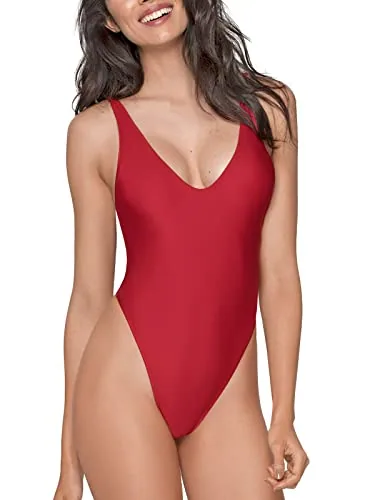
One Piece
Thong One Piece, Red (Large)
thong
4.4 out of 5 · 4,541 ratings$26.99+5
A swimsuit rarely dies of use. It dies of chlorine, heat, oil and sun, and knowing which one you are up against decides what to do about it.

A swimsuit that has gone baggy at the seat, gone dull in colour or gone slack at the straps has not worn out in the way a shirt wears out. One specific fibre in it has been destroyed, and everything else in the garment is usually still fine.
That is good news, because it means the damage has causes you can name and mostly avoid.
Swim fabric is a knit of nylon or polyester with a small proportion of a second fibre running through it. The federal fibre rules define that second fibre exactly.
A manufactured fiber in which the fiber-forming substance is a long chain synthetic polymer comprised of at least 85 percent of a segmented polyurethane.
Segmented polyurethane is a plastic that behaves like rubber. It stretches to several times its length and returns, which is the entire reason a swimsuit holds a body. It is also the part that chemicals, heat and ultraviolet light attack.
The nylon around it is tough. It survives salt, sun and years of use. So when a suit gives up, what has actually happened is that the spandex has broken down inside a fabric that otherwise looks intact. That is why a dead swimsuit still feels like fabric and simply will not hold.
It is also why the amount matters. Fibres present at five percent or more of the weight have to be named.
the respective generic names of all fibers present in the amount of 5 per centum or more of the total fiber weight of the textile fiber product shall be used when naming fibers in the required information
A swim fabric will usually sit between twelve and twenty percent spandex. Read the content line and you know roughly how much stretch you are buying and how much there is to lose.
Pool water is an oxidising environment by design. It is meant to destroy organic material, and spandex is organic enough to count.
What is worth understanding is how quickly the chemistry works. The Centers for Disease Control describe the mechanism plainly.
Chemicals (chlorine or bromine) inactivate or kill most germs in properly treated water within minutes.
Minutes, not hours. The same speed that makes a pool safe makes it hard on fabric, and a suit sitting damp in a bag after swimming is still soaking in that chemistry long after you have left.
Public pools ask everyone to shower before getting in, and the reason is not politeness.
A one-minute shower removes most of the dirt, sweat, and oils on your body that use up the pool chemicals needed to kill germs.
The chemistry connects directly to your swimsuit. Chlorine consumed by body oils and sun cream is replaced by the pool operator, usually by adding more, and a pool running at a higher chlorine level to cope with what swimmers bring in is a harsher environment for fabric. A rinse before you swim is genuinely in your own interest.
Rinse in cold fresh water the moment you are out, before anything dries. This one habit outperforms every other on the list, and it takes about thirty seconds.
Cold, not warm. Warm water opens the knit and helps the chemistry rather than stopping it.
The sea does not oxidise fabric the way a pool does, so a swimsuit lives longer in it. What salt does instead is crystallise as the suit dries, and salt crystals are abrasive. Fabric flexed with crystals in it wears from the inside.
The remedy is the same rinse, for the same reason: get it out before it dries in. A suit that has been rinsed after the sea is in better condition than one that has never been in the sea at all but has been left crusted twice.
Ask anyone what ruins swimwear and they will say chlorine. Heat is the more reliable destroyer, because it is applied deliberately and at temperatures the fibre cannot survive.
| Source | What happens | Verdict |
|---|---|---|
| Tumble dryer | Direct heat degrades the fibre in a single cycle | Never |
| Hot wash | Breaks down the fibre and sets any oil marks permanently | Never |
| Hot tub | Heat plus high chlorine, working together | Rinse straight after, expect a short life |
| Car boot in summer | Hours at high temperature while damp | Avoid, and never store one there |
| Direct midday sun to dry | Fades dye and degrades fibre at the surface | Dry in shade |
| Radiator or hot rail | Sustained contact heat | Dry flat instead |
A single tumble dry can take more life out of a swimsuit than a season of swimming. If you take one thing from this piece, take that.
Sun cream is necessary and it is hard on swimwear. The oils carry into the knit and the chemical filters can react with dye, and both effects are worst on pale fabric where there is no colour to hide them.
Mineral formulas containing zinc or titanium are the ones most likely to leave a mark that does not wash out, and they are also the ones many people prefer on their skin. That is a genuine conflict rather than a problem with a clean answer.
What helps is sequence. Put sun cream on, let it absorb for ten minutes, then put the swimsuit on. Most of the transfer happens when wet cream meets dry fabric.
Everything above collapses into a short sequence that becomes automatic after a week.
That is the whole method. It costs five minutes a day at most and roughly doubles how long a suit stays worth wearing.
The instructions printed on a swimsuit are not generic. There is a rule requiring whoever prints them to stand behind them.
To fail to possess, prior to sale, a reasonable basis for all regular care information disclosed to the purchaser.
So the label is telling you where the limits are. Hand wash only means the machine will damage it. Do not tumble dry means heat will end it. A label allowing a cool machine cycle is telling you the construction is robust enough for one, which is itself useful information about what you have bought.
The piece on buying a swimsuit without trying it on reads the same label from the fitting side, since a suit that shrinks or slackens has stopped fitting as surely as one bought in the wrong size.
Most swimwear spends nine months of the year in a drawer, and a surprising amount of damage happens there rather than in the water.
Put it away completely dry. A suit stored damp grows mildew, and mildew on swim fabric does not come out. Fold rather than hang, because a hanger stretches the straps over months just as it does over hours.
Keep it out of direct light and away from heat. A drawer is better than a shelf by a window, and anywhere in the house is better than a car, a loft or a garage where summer temperatures run high.
Do not store it in a sealed plastic bag. Swim fabric needs to breathe, and trapped moisture in plastic is exactly the condition mildew wants.
The arithmetic is worth doing once, because it changes how the five minutes feel.
A suit worn twice a week through a summer gets about thirty wears. Treated carelessly, most swimwear at this price is finished after one season. Rinsed, dried flat and kept out of the dryer, the same suit comfortably does three.
That is the difference between a cost per wear of about a dollar and one of about thirty cents, on a garment where the care routine costs nothing but attention. It is the best return available anywhere in a wardrobe.
It also changes what is worth buying. A structured piece with a moulded cup and a proper underwire is a poor purchase if it dies in one season, and a genuinely good one if it lasts three. The care routine is what decides which of those you get, more than the price does.
Three signs, and none of them is fading.
The fabric no longer pulls back when you stretch it across the seat. The straps have stopped holding position no matter how you adjust them. The knit has gone thin enough to be translucent when dry rather than only when wet. Any one of the three means the spandex has gone, and no amount of care brings it back.
Colour that has faded is a different matter entirely. A faded suit that still holds is a perfectly good suit, and it is worth separating the two before replacing anything. Most of what gets thrown out is faded rather than dead.
Where this came from
Office of the Federal Register
16 CFR Part 303, Rules under the Textile Fiber Products Identification Act
U.S. Centers for Disease Control and Prevention
Preventing Swimming-related Illnesses, Healthy Swimming
Office of the Federal Register
16 CFR Part 423, Care Labeling of Textile Wearing Apparel
Every source above was opened and read on the date shown. Where a page says something we cannot verify ourselves, we quote it and name it rather than restating it as our own.
Shop what this piece is about
thong
4.4 out of 5 · 4,541 ratings
high cut · scoop
4.4 out of 5 · 4,541 ratingshigh cut · scoop
4.4 out of 5 · 4,541 ratingsthong
4.4 out of 5 · 4,541 ratingsKeep reading

The four measurements that matter, why swim fabric behaves unlike anything else in your wardrobe, and how to read a cut before it arrives.
1,838 words
Twenty terms that appear on every swimwear description, what each one actually describes, and which of them mean nothing at all.
1,608 words